Skip opening
POP’S PROJECTSNormandy Stories / 001
Silent edition · audio off by default

Caligny, Normandy · A single Commonwealth grave

A lone
grave.

Pilot Officer Ernest George Boucher
174 Squadron RAF
1922–1944
Begin the story
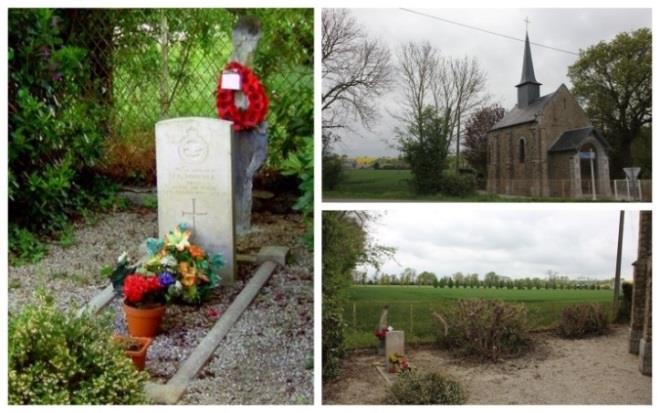
Composite of George’s flower-covered grave, the chapel and its rural surroundings.
Amber · Booklet p. 3George’s grave and the Chapel of Our Lady of the Oak, shown in a booklet composite.
Inspect: A grave beside a chapel

Archive object · chapel

A grave beside a chapel

George’s grave and the Chapel of Our Lady of the Oak, shown in a booklet composite.

George Boucher — The Man Who Came BackNormandy Stories · Part one

00 / Caligny · 1922–1944

Where the story ends

In the grounds of the Chapel of Our Lady of the Oak, at Caligny in Normandy, stands a single Commonwealth grave.

Pilot Officer Ernest George Boucher. 174 Squadron RAF. Born on 30 December 1922; killed on 5 August 1944, aged twenty-one.

To find George before this place, we must go back.
Sources / How do we know?

The evidence behind the story

How do we know?

This exhibition extends Colin Mowl’s commemorative booklet. The sources below record the provenance of its narrative, photographs and reconstructed route.

SECONDARY RECONSTRUCTION

Digital Exhibition Pack

5 September 2026 · Supplied research brief, §§2–5, 7–11

The factual brief for this exhibition. Summarises Colin Mowl’s 2015 booklet and identifies its underlying records.

SECONDARY RECONSTRUCTION

Colin Mowl’s commemorative booklet

2015 · 24-page booklet; embedded images supplied in research ZIP

Prepared for the Caligny plaque unveiling on 6 June 2015. The ZIP contains image extractions, not the complete booklet PDF. The booklet identifies George in the 1934 King Edward VI School class photograph: aged 12, seated two places to the right of the master.

Reading the evidence

  • PRIMARY / CONTEMPORARY
  • FIRST-HAND LATER
  • SECONDARY RECONSTRUCTION
  • LATER RECOLLECTION
  • INFERENCE / UNRESOLVED

Booklet-derived imagery remains Amber. Australian War Memorial downloads are separately recorded as public domain in their archive metadata.

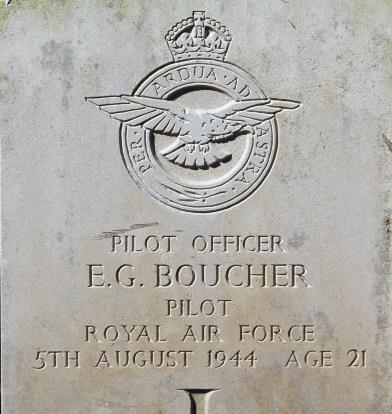
RAF badge and inscription on George Boucher’s headstone.
Amber · Booklet p. 3Detail of George Boucher’s Commonwealth War Graves headstone.
Inspect: The name in stone

Archive object · headstone

The name in stone

Detail of George Boucher’s Commonwealth War Graves headstone.

Transcription

Selected inscription: “PILOT OFFICER / E. G. BOUCHER / ROYAL AIR FORCE / 5TH AUGUST 1944 AGE 21”.

Selected visible text only; not a full diplomatic transcription.

But this is only
where the story ends.1944 1934

01 / Before the uniform

The Pilot

First, a schoolboy.
A brother. George.
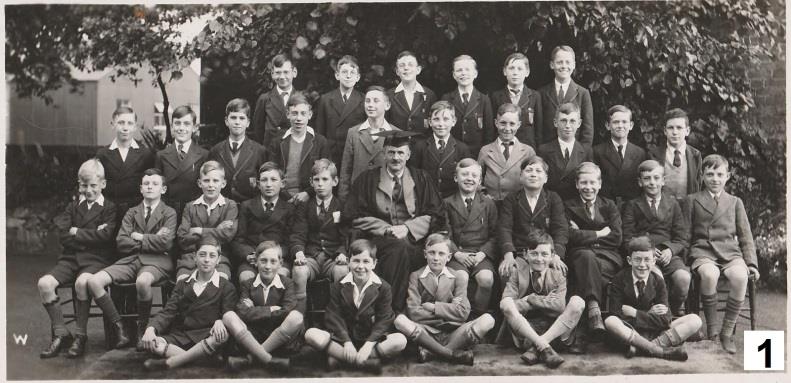
School class arranged in rows, with George highlighted, seated two places to the right of the master.
Amber · Booklet p. 23George, aged 12, at King Edward VI School, Stourbridge, 1934.
Inspect: Before the RAF

Archive object · school

Before the RAF

George, aged 12, at King Edward VI School, Stourbridge, 1934.

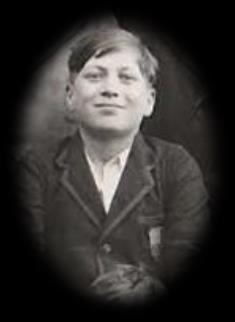
George as a schoolboy, in a jacket and tie.
Amber · Booklet p. 23A school-age portrait of George.
Inspect: George, a schoolboy

Archive object · schoolboy

George, a schoolboy

A school-age portrait of George.

King Edward VI School, Stourbridge.
The class photograph was taken in 1934.

A family album

With Alec.
At home.

Born on 30 December 1922, George worked as an Air Ministry clerk before joining the RAF in February 1941.
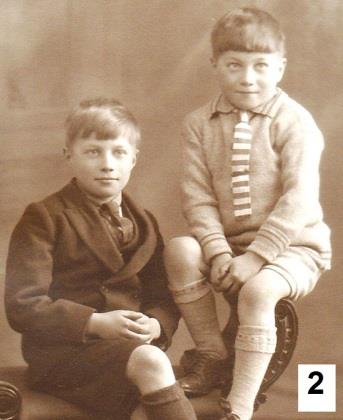
Family photograph of George and his elder brother Alec as children.
Amber · Booklet p. 23George with his elder brother Alec.
Inspect: George and Alec

Archive object · brother

George and Alec

George with his elder brother Alec.

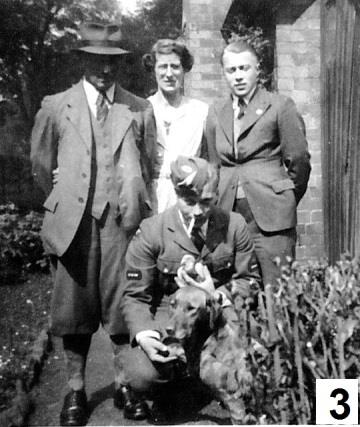
George in uniform with members of his family outdoors.
Amber · Booklet p. 23George on leave with family; a photograph from the family booklet.
Inspect: Home on leave

Archive object · leave

Home on leave

George on leave with family; a photograph from the family booklet.

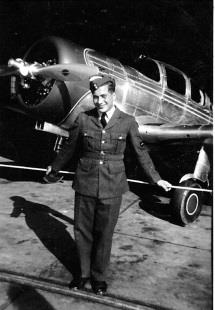
George standing beside a training aircraft.
Amber · Booklet p. 3George during pilot training in North America.
Inspect: Across the Atlantic

Archive object · training

Across the Atlantic

George during pilot training in North America.

1941–1942 / Across the Atlantic

A wider world.

Pilot training took George to North America. In 1942 he joined 174 Squadron. The Dieppe Raid became his first truly operational sortie.
Sources / How do we know?

The evidence behind the story

How do we know?

This exhibition extends Colin Mowl’s commemorative booklet. The sources below record the provenance of its narrative, photographs and reconstructed route.

SECONDARY RECONSTRUCTION

Digital Exhibition Pack

5 September 2026 · Supplied research brief, §§2–5, 7–11

The factual brief for this exhibition. Summarises Colin Mowl’s 2015 booklet and identifies its underlying records.

SECONDARY RECONSTRUCTION

Colin Mowl’s commemorative booklet

2015 · 24-page booklet; embedded images supplied in research ZIP

Prepared for the Caligny plaque unveiling on 6 June 2015. The ZIP contains image extractions, not the complete booklet PDF. The booklet identifies George in the 1934 King Edward VI School class photograph: aged 12, seated two places to the right of the master.

Reading the evidence

  • PRIMARY / CONTEMPORARY
  • FIRST-HAND LATER
  • SECONDARY RECONSTRUCTION
  • LATER RECOLLECTION
  • INFERENCE / UNRESOLVED

Booklet-derived imagery remains Amber. Australian War Memorial downloads are separately recorded as public domain in their archive metadata.

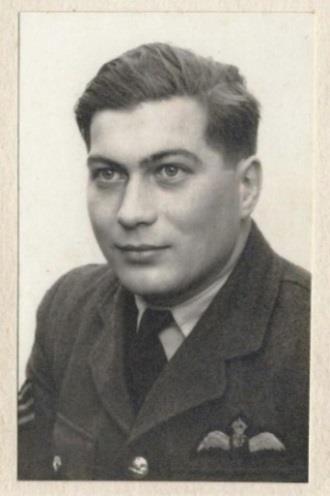
Portrait of George Boucher in RAF uniform.
Amber · Booklet p. 14Portrait of George reproduced in the family booklet.
Inspect: George Boucher

Archive object · portrait

George Boucher

Portrait of George reproduced in the family booklet.

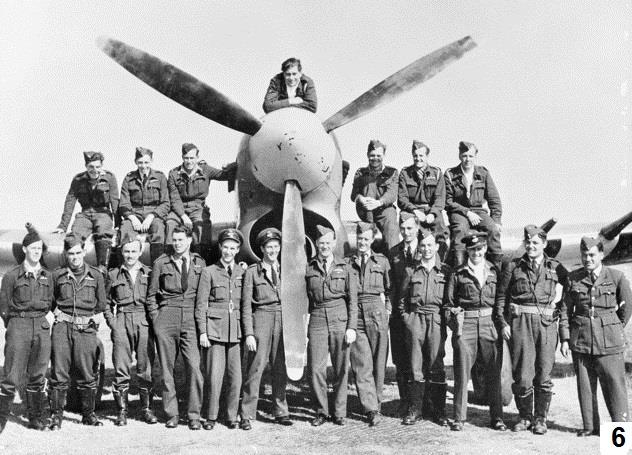
George perched on the propeller of a Typhoon, with squadron personnel standing below.
Amber · Booklet p. 24George on a Typhoon propeller, above a group of squadron personnel.
Inspect: On a Typhoon propeller

Archive object · propeller

On a Typhoon propeller

George on a Typhoon propeller, above a group of squadron personnel.

174 Squadron

Among his
squadron.

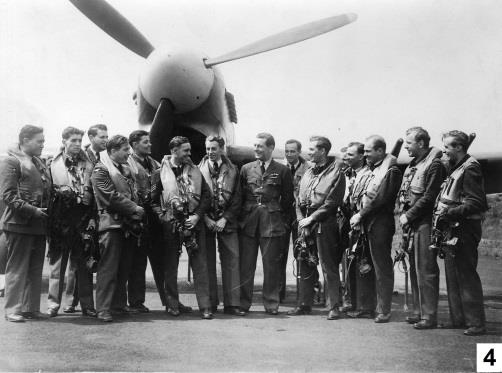
174 Squadron pilots standing together in front of an aircraft.
Amber · Booklet p. 24174 Squadron pilots; George is fourth from the left.
Inspect: Among his squadron

Archive object · squadron

Among his squadron

174 Squadron pilots; George is fourth from the left.

02 / Sixteen minutes

5 October
1943

From George’s Escape & Evasion Report

“train-busting
rhubarb”
Schematic connection from Lydd across the Channel to the railway south of Étaples and the forced landing near Montreuil. Not an exact flight path.LYDD · 11:20THE CHANNELSouth of ÉtaplesNear Montreuil · 11:36
Editorial orientation sketch · dashed line indicates approximate movement, not the flight path.
  1. 11:20

    Lydd

    Departure from Kent.

  2. After departure

    South of Étaples

    Train attack; exact target point unconfirmed.

  3. In flight

    Engine fire

    George believed debris had struck the Typhoon.

  4. 11:36

    Near Montreuil

    Forced landing, then concealment near the aircraft.

The National Archives / Record reference

WO 208/3316/1595

PRIMARY / CONTEMPORARY

George’s contemporary account is the source behind this sequence.

Read the account summary

George departed Lydd at about 11:20, attacked a train south of Étaples and believed debris from the target struck his Typhoon. His engine caught fire. At 11:36 he made a forced landing near Montreuil and hid nearby.

Editorial paraphrase of the research brief, §3. Not a transcription. Debris striking the aircraft was George’s belief, not an independently established cause.

Inspect the record reference

The evidence behind the story

How do we know?

This exhibition extends Colin Mowl’s commemorative booklet. The sources below record the provenance of its narrative, photographs and reconstructed route.

SECONDARY RECONSTRUCTION

Digital Exhibition Pack

5 September 2026 · Supplied research brief, §§2–5, 7–11

The factual brief for this exhibition. Summarises Colin Mowl’s 2015 booklet and identifies its underlying records.

PRIMARY / CONTEMPORARY

George Boucher’s Escape & Evasion Report

1943 · The National Archives · WO 208/3316/1595

George Boucher’s Escape & Evasion Report, reproduced in Colin Mowl’s source booklet. The Orchard quotation follows the wording reproduced there.

Reading the evidence

  • PRIMARY / CONTEMPORARY
  • FIRST-HAND LATER
  • SECONDARY RECONSTRUCTION
  • LATER RECOLLECTION
  • INFERENCE / UNRESOLVED

Booklet-derived imagery remains Amber. Australian War Memorial downloads are separately recorded as public domain in their archive metadata.

03 / 5 October 1943 · Near Montreuil

The Orchard

04 / October 1943 · France → Spain

A way through France

Survival now depended on other people. From one refuge to the next, George travelled south through occupied France.

The record preserves names of places. It does not preserve every road between them. Follow the documented stops below.

Sources / How do we know?

The evidence behind the story

How do we know?

This exhibition extends Colin Mowl’s commemorative booklet. The sources below record the provenance of its narrative, photographs and reconstructed route.

SECONDARY RECONSTRUCTION

Digital Exhibition Pack

5 September 2026 · Supplied research brief, §§2–5, 7–11

The factual brief for this exhibition. Summarises Colin Mowl’s 2015 booklet and identifies its underlying records.

PRIMARY / CONTEMPORARY

George Boucher’s Escape & Evasion Report

1943 · The National Archives · WO 208/3316/1595

George Boucher’s Escape & Evasion Report, reproduced in Colin Mowl’s source booklet. The Orchard quotation follows the wording reproduced there.

INFERENCE / UNRESOLVED

Reconstructing the escape

October 1943 · Research brief §§3, 5, 7–8; booklet route map, p. 6

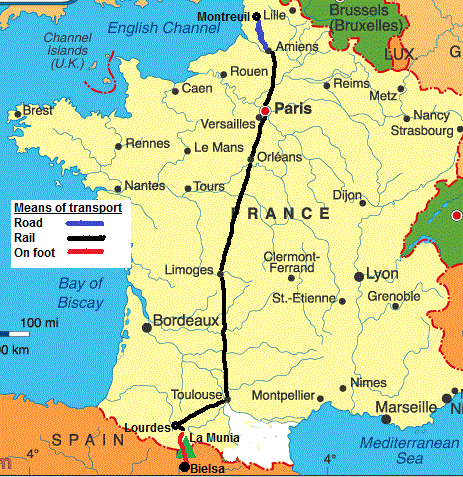
Named stops are documented in the supplied reconstruction. The diagram is schematic and not to scale. Dashed segments indicate approximate connections, not roads, paths or border-crossing coordinates. La Munia is an area, not a confirmed pass.

Reading the evidence

  • PRIMARY / CONTEMPORARY
  • FIRST-HAND LATER
  • SECONDARY RECONSTRUCTION
  • LATER RECOLLECTION
  • INFERENCE / UNRESOLVED

Booklet-derived imagery remains Amber. Australian War Memorial downloads are separately recorded as public domain in their archive metadata.

The whole journey

George’s escape from northern France to Bielsa — The whole journeySchematic, not to scale. Solid numbered markers are documented places or areas. Dashed lines are approximate connections, never exact roads or paths. Terrain lines are an editorial impression, not elevation data. The full itinerary follows the map.N ↑FRANCESPAINPYRENEES1Montreuil2Renty3Auxi-le-Château4Amiens5Paris6Toulouse7Lourdes8Tarbes9Pouzac10La Munia11Bielsa
Montreuil → BielsaFrance → Spain
● Documented place / area┄ Approximate connectionSchematic · not to scale
Reading this map

No exact roads or mountain pass are claimed. Positions and terrain lines are editorial, not surveyed coordinates or measured elevations. The map reframes between regions; its scale changes.

Route evidence

The evidence behind the story

How do we know?

This exhibition extends Colin Mowl’s commemorative booklet. The sources below record the provenance of its narrative, photographs and reconstructed route.

SECONDARY RECONSTRUCTION

Digital Exhibition Pack

5 September 2026 · Supplied research brief, §§2–5, 7–11

The factual brief for this exhibition. Summarises Colin Mowl’s 2015 booklet and identifies its underlying records.

PRIMARY / CONTEMPORARY

George Boucher’s Escape & Evasion Report

1943 · The National Archives · WO 208/3316/1595

George Boucher’s Escape & Evasion Report, reproduced in Colin Mowl’s source booklet. The Orchard quotation follows the wording reproduced there.

INFERENCE / UNRESOLVED

Reconstructing the escape

October 1943 · Research brief §§3, 5, 7–8; booklet route map, p. 6

Named stops are documented in the supplied reconstruction. The diagram is schematic and not to scale. Dashed segments indicate approximate connections, not roads, paths or border-crossing coordinates. La Munia is an area, not a confirmed pass.

Reading the evidence

  • PRIMARY / CONTEMPORARY
  • FIRST-HAND LATER
  • SECONDARY RECONSTRUCTION
  • LATER RECOLLECTION
  • INFERENCE / UNRESOLVED

Booklet-derived imagery remains Amber. Australian War Memorial downloads are separately recorded as public domain in their archive metadata.

  1. I. Northern France

    01 / From 5 October

    Montreuil / Bois Jean

    After the forced landing near Montreuil, help came from Mme Thille and her son. Bois Jean is recorded as an early place of assistance.

    SECONDARY RECONSTRUCTION
  2. 02 / October · date unspecified

    Renty

    The Fillerin family at Renty formed part of the chain of help that moved George away from the crash area.

    SECONDARY RECONSTRUCTION
  3. 03 / October · six-day stay

    Auxi-le-Château

    George stayed at Auxi-le-Château for six days.

    SECONDARY RECONSTRUCTION
  4. 04 / October · date unspecified

    Amiens

    Amiens is documented as an onward transit point. The precise connection is not established here.

    SECONDARY RECONSTRUCTION
  5. 05 / 21 October · departure

    Paris

    Sheltered in the office of Maître Bazille, George later left Gare d’Austerlitz with false papers on 21 October.

    SECONDARY RECONSTRUCTION
  6. II. The journey south

    06 / After Paris · October

    Toulouse

    The journey south passed through Toulouse, before continuing towards Lourdes.

    SECONDARY RECONSTRUCTION
  7. 07 / October · two nights

    Lourdes

    George spent two nights at Lourdes before moving towards the mountains.

    SECONDARY RECONSTRUCTION
  8. 08 / 24 October

    Tarbes

    George travelled by train via Tarbes to Pouzac on 24 October.

    SECONDARY RECONSTRUCTION
  9. III. On foot, across the mountains

    09 / 24 October

    Pouzac

    The party grew to 34 people, with two guides. A prolonged crossing on foot followed.

    SECONDARY RECONSTRUCTION
  10. 10 / 24–26 October

    La Munia / Pyrenees

    On 26 October, north of La Munia, George and six others pushed on rather than remain in a frontier hut. The precise pass is uncertain.

    SECONDARY RECONSTRUCTION
  11. 11 / After the mountain crossing

    Bielsa

    Suffering from snow blindness, George was arrested by Spanish frontier police at Bielsa. Crossing the mountains had not yet brought him home.

    SECONDARY RECONSTRUCTION
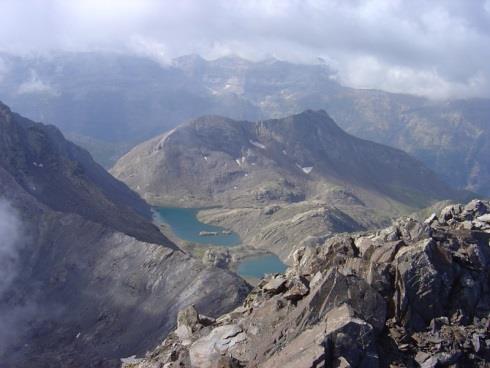
Rocky mountain slopes and a lake in the Pyrenees.
Amber · Booklet p. 6Pyrenees / La Munia landscape reproduced beside the escape account. Context image, not a photograph of George’s crossing.
Inspect: The mountain landscape

Archive object · mountains

The mountain landscape

Pyrenees / La Munia landscape reproduced beside the escape account. Context image, not a photograph of George’s crossing.

At the frontier

Beyond the mountains,
another wait.

At Bielsa, George was detained in Spain. Before following him home, meet the people who helped him reach the frontier.

Sources / How do we know?

The evidence behind the story

How do we know?

This exhibition extends Colin Mowl’s commemorative booklet. The sources below record the provenance of its narrative, photographs and reconstructed route.

SECONDARY RECONSTRUCTION

Digital Exhibition Pack

5 September 2026 · Supplied research brief, §§2–5, 7–11

The factual brief for this exhibition. Summarises Colin Mowl’s 2015 booklet and identifies its underlying records.

PRIMARY / CONTEMPORARY

George Boucher’s Escape & Evasion Report

1943 · The National Archives · WO 208/3316/1595

George Boucher’s Escape & Evasion Report, reproduced in Colin Mowl’s source booklet. The Orchard quotation follows the wording reproduced there.

Reading the evidence

  • PRIMARY / CONTEMPORARY
  • FIRST-HAND LATER
  • SECONDARY RECONSTRUCTION
  • LATER RECOLLECTION
  • INFERENCE / UNRESOLVED

Booklet-derived imagery remains Amber. Australian War Memorial downloads are separately recorded as public domain in their archive metadata.

05 / The people behind the journey

One person.
Then another.

Across France, George’s survival depended on strangers who chose to help.

  1. Montreuil / Bois Jean · From 5 October 1943

    Mme Thille and her son

    The first help, close to the place where his aircraft came down. A stranger could become the next refuge.

  2. Renty · October 1943

    Marguerite, Geneviève & Monique Fillerin

    Norbert Fillerin had been arrested. The women of the family continued the work of helping evaders.

  3. Ternois / escape networks · 1943

    René Guittard · Joseph Becker

    Guittard was associated with Bordeaux-Loupiac. Becker, the driver George had taken for a German, was connected to the escape network.

    Bordeaux-Loupiac Escape Network
  4. Paris · Before departure on 21 October

    Maître Bazille

    A lawyer’s office became a shelter. George left Gare d’Austerlitz with false papers on 21 October.

Alongside George / A fellow evader

Sgt H. E. R. Merlin

Another pilot, from 175 Squadron, accompanied George for part of the journey. He, too, needed a way home.

How an escape line worked

An escape line joined small acts of help: a hiding place, an escort, false papers, somewhere to wait. In George’s journey, those acts took place in homes and in a Paris lawyer’s office. Families and local contacts worked with wider networks to help evaders move through occupied territory.

The Fillerins show how personal that work was. After Norbert’s arrest, Marguerite, Geneviève and Monique continued. For an evader, the next person could mean another night of shelter and a chance to move on.

Sources / How do we know?

The evidence behind the story

How do we know?

This exhibition extends Colin Mowl’s commemorative booklet. The sources below record the provenance of its narrative, photographs and reconstructed route.

SECONDARY RECONSTRUCTION

The people along the escape line

October 1943 · Colin Mowl’s booklet; research pack, chapters 5 and 8 (people index)

Mme Thille and her son helped near Montreuil; the Fillerin family worked at Renty; Maître Bazille sheltered George in Paris. Norbert Fillerin had been arrested: Marguerite, Geneviève and Monique continued the work. René Guittard is associated with Bordeaux-Loupiac in Ternois. Joseph Becker was a network-linked driver; Merlin was a fellow evader, not a helper. The connecting thread groups documented associations and refuges; it does not assert a complete sequence of personal hand-offs or dates.

SECONDARY RECONSTRUCTION

Networks behind the helpers

1943 · Research pack, chapter 5 and people index

The booklet connects René Guittard and Joseph Becker with Bordeaux-Loupiac. Supplementary research connects Norbert Fillerin with Pat O’Leary. These associations are shown separately from George’s documented shelters; no direct meeting with the arrested Norbert is implied.

PRIMARY / CONTEMPORARY

George Boucher’s Escape & Evasion Report

1943 · The National Archives · WO 208/3316/1595

George Boucher’s Escape & Evasion Report, reproduced in Colin Mowl’s source booklet. The Orchard quotation follows the wording reproduced there.

Reading the evidence

  • PRIMARY / CONTEMPORARY
  • FIRST-HAND LATER
  • SECONDARY RECONSTRUCTION
  • LATER RECOLLECTION
  • INFERENCE / UNRESOLVED

Booklet-derived imagery remains Amber. Australian War Memorial downloads are separately recorded as public domain in their archive metadata.

06 / Spain → Gibraltar → Britain

Home.
At last.

After the crossing and his arrest at Bielsa, George was detained in Spain. He returned via Gibraltar.

30 November
1943

George arrived back in the United Kingdom.

Sources / How do we know?

The evidence behind the story

How do we know?

This exhibition extends Colin Mowl’s commemorative booklet. The sources below record the provenance of its narrative, photographs and reconstructed route.

SECONDARY RECONSTRUCTION

The journey home

October–November 1943 · Colin Mowl’s booklet; supplied Milestone B chronology

Detention in Spain after Bielsa, return via Gibraltar, arrival in the UK on 30 November 1943. The homeward map connects these known stages schematically; no exact transit route, detention itinerary or transport mode is supplied.

PRIMARY / CONTEMPORARY

George Boucher’s Escape & Evasion Report

1943 · The National Archives · WO 208/3316/1595

George Boucher’s Escape & Evasion Report, reproduced in Colin Mowl’s source booklet. The Orchard quotation follows the wording reproduced there.

Reading the evidence

  • PRIMARY / CONTEMPORARY
  • FIRST-HAND LATER
  • SECONDARY RECONSTRUCTION
  • LATER RECOLLECTION
  • INFERENCE / UNRESOLVED

Booklet-derived imagery remains Amber. Australian War Memorial downloads are separately recorded as public domain in their archive metadata.

From Bielsa to Britain, via GibraltarSchematic homeward journey. George was detained in Spain after Bielsa, returned via Gibraltar and arrived in Britain on 30 November 1943. Dashed connections are not exact routes.BIELSADetention in SpainGIBRALTARBRITAIN30 November 1943SPAINFRANCE
Known stages of the journey home · schematic, not to scale.

07 / January 1944

He survived.
He went back.

George rejoined 174 Squadron. The escape had brought him home. It had not ended his war.
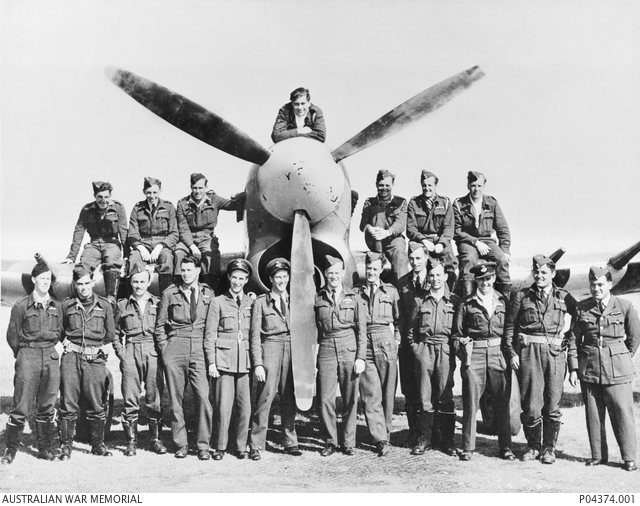
174 Squadron group portrait with George fourth from the left in the back row, at the top.
Australian War Memorial · P04374.001174 Squadron, January–August 1943, before George’s escape. George is fourth from the left in the back row, at the top.
Inspect: The men of 174 Squadron

Archive object · awm-group

The men of 174 Squadron

174 Squadron, January–August 1943, before George’s escape. George is fourth from the left in the back row, at the top.

A familiar squadron

The men, the aircraft, the work. George returned to active service in January 1944.
  1. Back with 174 Squadron.
  2. Among the squadron’s pilots after a mission.
  3. Living and flying from B5, Normandy.
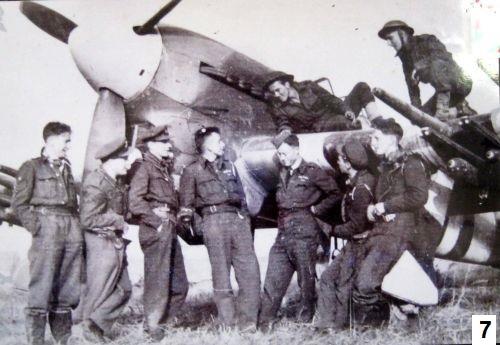
174 Squadron pilots gathered together; George stands second from the left.
Amber · Booklet p. 24174 Squadron after the 23 June 1944 mission. George is second from the left.
Inspect: Back among the pilots

Archive object · june-squadron

Back among the pilots

174 Squadron after the 23 June 1944 mission. George is second from the left.

Sources / How do we know?

The evidence behind the story

How do we know?

This exhibition extends Colin Mowl’s commemorative booklet. The sources below record the provenance of its narrative, photographs and reconstructed route.

SECONDARY RECONSTRUCTION

Return to 174 Squadron

January 1944 · Colin Mowl’s booklet; research pack, chapter 6

George returned to active service with 174 Squadron in January 1944. The AWM group photograph is dated January–August 1943, before his escape, and is captioned accordingly. The 23 June 1944 photograph is reproduced on booklet p. 24.

PRIMARY / CONTEMPORARY

174 Squadron group portrait

January–August 1943 · Australian War Memorial · P04374.001

AWM identifies Ernest George Boucher fourth from the left in the back row, at the top. This is an earlier squadron photograph, not a photograph of his January 1944 return or of B5. Copyright expired / public domain; downloaded on 6 September 2026.

View catalogue record ↗
SECONDARY RECONSTRUCTION

Colin Mowl’s commemorative booklet

2015 · 24-page booklet; embedded images supplied in research ZIP

Prepared for the Caligny plaque unveiling on 6 June 2015. The ZIP contains image extractions, not the complete booklet PDF. The booklet identifies George in the 1934 King Edward VI School class photograph: aged 12, seated two places to the right of the master.

Reading the evidence

  • PRIMARY / CONTEMPORARY
  • FIRST-HAND LATER
  • SECONDARY RECONSTRUCTION
  • LATER RECOLLECTION
  • INFERENCE / UNRESOLVED

Booklet-derived imagery remains Amber. Australian War Memorial downloads are separately recorded as public domain in their archive metadata.

08 / Le Fresne-Camilly · Normandy

An airfield.
A daily world.

B5. Tents beside the aircraft. Washing on a line. Work that began again.

174 SQUADRON / NORMANDY / JULY 1944
His squadron. At work.
About this silent film

RAF Film Production Unit, 7–8 July 1944. A 2 minute 38 second excerpt (04:46–07:24 in AWM’s downloadable file) of 174 Squadron’s working day: washing, servicing and preparation. The photograph shown before playback is a separate view of the squadron at B5.

Australian War Memorial · F02596 · Public domain. No soundtrack has been added. George is not individually identified in this film.

Full film and catalogue record ↗

01 / Between flights

Washing.
Waiting.

A tent was somewhere to sleep. A dugout offered protection from falling shrapnel.

02 / On the ground

Prepare.
Service. Load.

Ground crews worked on engines and armament. Rockets and cannon ammunition had to be readied.

03 / Back to the aircraft

Another flight.
Then another.

Pilots boarded. Typhoons departed. The work on the ground continued.
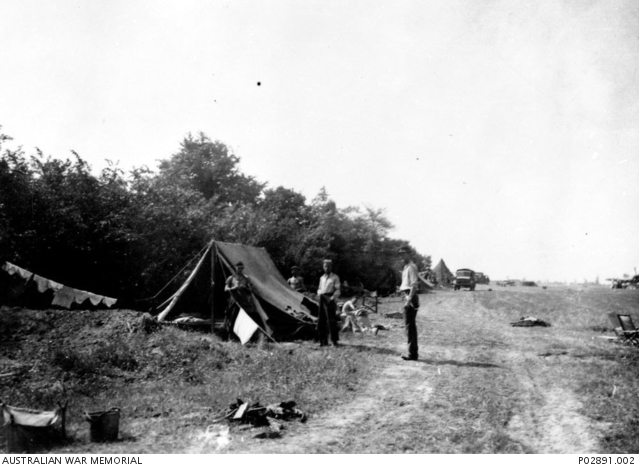
A tent and washing line beside a protective dugout; squadron members and a Typhoon at B5.
Australian War Memorial · P02891.002174 Squadron at B5, July 1944. A tent, a dugout, washing on the line.
Inspect: A place to live, beside the aircraft

Archive object · awm-b5

A place to live, beside the aircraft

174 Squadron at B5, July 1944. A tent, a dugout, washing on the line.

“Just sleeping,
eating, flying,
playing poker…”Jimmie Spencer
Sources / How do we know?

The evidence behind the story

How do we know?

This exhibition extends Colin Mowl’s commemorative booklet. The sources below record the provenance of its narrative, photographs and reconstructed route.

PRIMARY / CONTEMPORARY

Life beside the airfield

July 1944 · Australian War Memorial · P02891.002

Members of 174 Squadron at B5 beside a tent, protective dugout and washing line, with a Typhoon nearby. George is not identified in this photograph. AWM marks copyright expired / public domain. Downloaded from the catalogue’s public image link on 6 September 2026.

View catalogue record ↗
PRIMARY / CONTEMPORARY

RAF coverage Caen (Ops T86 C/B 62)

7–8 July 1944 · Australian War Memorial · F02596 · RAF Film Production Unit

A 27-minute black-and-white silent film, marked copyright expired / public domain by AWM. The catalogue identifies a sequence of 174 Squadron laundry, maintenance, armament preparation and aircraft departures. The full reel also covers other units. Only the reviewed squadron ground sequence is used here; no person in the film is identified as George. See film metadata for the exact excerpt.

View catalogue record ↗
LATER RECOLLECTION

Jimmie Spencer’s recollection

Later recollection · Colin Mowl’s booklet; research pack, chapters 6–7

The research pack reproduces the short wording “Just sleeping, eating, flying, playing poker...” and recalls the jacket inscription “The man who came back.” Only those supplied words are quoted. The complete recollection and a jacket photograph are not recreated.

Reading the evidence

  • PRIMARY / CONTEMPORARY
  • FIRST-HAND LATER
  • SECONDARY RECONSTRUCTION
  • LATER RECOLLECTION
  • INFERENCE / UNRESOLVED

Booklet-derived imagery remains Amber. Australian War Memorial downloads are separately recorded as public domain in their archive metadata.

Late July / Early August 1944

Nine sorties.
Seven days.

After bad weather, the pace of operations quickened. George was among the squadron’s busiest pilots.

Recent targets included Bréville, Falaise, the Seine and Rouen. During the Normandy campaign, 174 Squadron lost pilots.

Sources / How do we know?

The evidence behind the story

How do we know?

This exhibition extends Colin Mowl’s commemorative booklet. The sources below record the provenance of its narrative, photographs and reconstructed route.

SECONDARY RECONSTRUCTION

The last week of flying

Late July–5 August 1944 · Colin Mowl’s booklet; research pack, chapter 7; supplied Milestone B chronology

Nine sorties in the seven days before the final mission, with George among the busiest pilots. Recent targets included Bréville, Falaise, the Seine and Rouen. Activity intensified after bad weather; the squadron lost pilots during the Normandy campaign. The nine marks express a total only: they do not assign invented dates or targets to individual sorties.

LATER RECOLLECTION

Jimmie Spencer’s recollection

Later recollection · Colin Mowl’s booklet; research pack, chapters 6–7

The research pack reproduces the short wording “Just sleeping, eating, flying, playing poker...” and recalls the jacket inscription “The man who came back.” Only those supplied words are quoted. The complete recollection and a jacket photograph are not recreated.

Reading the evidence

  • PRIMARY / CONTEMPORARY
  • FIRST-HAND LATER
  • SECONDARY RECONSTRUCTION
  • LATER RECOLLECTION
  • INFERENCE / UNRESOLVED

Booklet-derived imagery remains Amber. Australian War Memorial downloads are separately recorded as public domain in their archive metadata.

30 July 1944 / A letter home

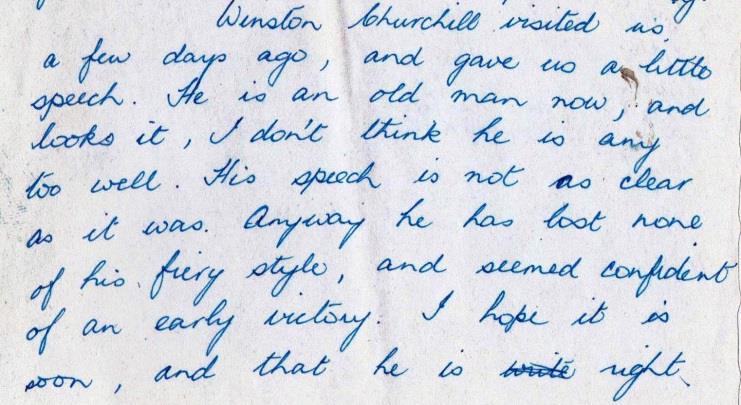
Excerpt of George’s handwritten letter home in blue ink.
Amber · Booklet p. 9George’s final letter home, 30 July 1944. An excerpt.
Inspect: A letter home

Archive object · last-letter

A letter home

George’s final letter home, 30 July 1944. An excerpt.

Transcription

“I hope it is soon, and that he is right”

Selected visible text only; not a full diplomatic transcription.

In the middle of it all, George wrote home.

Sources / How do we know?

The evidence behind the story

How do we know?

This exhibition extends Colin Mowl’s commemorative booklet. The sources below record the provenance of its narrative, photographs and reconstructed route.

PRIMARY / CONTEMPORARY

George’s final letter home

30 July 1944 · Family letter reproduced in Colin Mowl’s booklet, p. 9

A supplied excerpt of George’s handwritten final letter. The exhibition shows the actual extraction, without completing the letter or inventing missing text.

Reading the evidence

  • PRIMARY / CONTEMPORARY
  • FIRST-HAND LATER
  • SECONDARY RECONSTRUCTION
  • LATER RECOLLECTION
  • INFERENCE / UNRESOLVED

Booklet-derived imagery remains Amber. Australian War Memorial downloads are separately recorded as public domain in their archive metadata.

09 / Saturday 5 August 1944

20:15

B5 · Le Fresne-Camilly

Six aircraft.

George led Yellow Section

Yellow One.

The squadron record / 5 August 1944

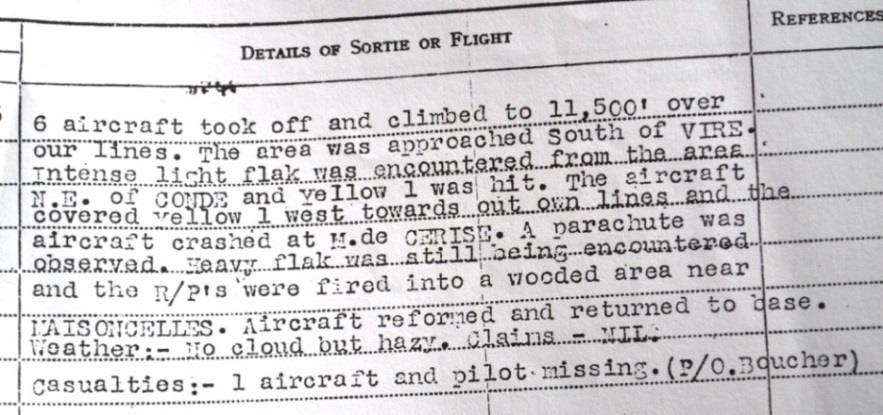
Typed squadron record. Relevant lines record intense light flak and Yellow 1 being hit.
Amber · Booklet p. 10174 Squadron’s record of the final sortie, 5 August 1944.
Inspect: The squadron record

Archive object · orb-extract

The squadron record

174 Squadron’s record of the final sortie, 5 August 1944.

Transcription

“Intense light flak was encountered from the area N.E. of CONDE and yellow 1 was hit.”

Selected visible text only; not a full diplomatic transcription.

Intense light flak.

Yellow One was hit.

He was seen to bail out.

His parachute opened.

His fellow pilots hoped he might return again.
“The man who came back.”

Sources / How do we know?

The evidence behind the story

How do we know?

This exhibition extends Colin Mowl’s commemorative booklet. The sources below record the provenance of its narrative, photographs and reconstructed route.

PRIMARY / CONTEMPORARY

Yellow One: the final sortie

Saturday 5 August 1944 · 174 Squadron record reproduced in the booklet, p. 10

Six aircraft took off from B5 at 20:15. George led Yellow Section. The record reports intense light flak, Yellow 1 being hit and a parachute observed. Grantham’s letter reports the bailout and the parachute opening. The narrative ends at his disappearance from the squadron’s view.

PRIMARY / CONTEMPORARY

174 Squadron Operations Record Book

5 August 1944 · The National Archives · AIR 27/1109 series; booklet extract, p. 10

The displayed object is the actual supplied booklet extract, not a reconstructed document. The research pack gives AIR 27/1109/16 as a catalogue lead only; the exact monthly item has not been verified and is not used as a formal citation. Highlighting marks only the lines about flak and Yellow 1 being hit. No German aircraft are reported in this contemporary evidence.

PRIMARY / CONTEMPORARY

Frederick Grantham’s letter to George’s father

After the 5 August 1944 mission · Colin Mowl’s booklet, p. 10; supplied letter excerpt

Grantham describes anti-aircraft fire hitting the engine, George’s No. 2 following him towards Allied lines, and the bailout and opening parachute. His letter expresses hope that George could escape again. The excerpt is available below as an archive object.

Typewritten letter from Grantham describing George’s bailout and hoping he would escape.
Amber · Booklet p. 10Frederick Grantham’s letter to George’s father after he was reported missing. An excerpt.
Inspect: Grantham writes home

Archive object · grantham-letter

Grantham writes home

Frederick Grantham’s letter to George’s father after he was reported missing. An excerpt.

Transcription

“he was seen to bale out and the parachute open shortly before the aircraft crashed.”

Selected visible text only; not a full diplomatic transcription.

LATER RECOLLECTION

Jimmie Spencer’s recollection

Later recollection · Colin Mowl’s booklet; research pack, chapters 6–7

The research pack reproduces the short wording “Just sleeping, eating, flying, playing poker...” and recalls the jacket inscription “The man who came back.” Only those supplied words are quoted. The complete recollection and a jacket photograph are not recreated.

Reading the evidence

  • PRIMARY / CONTEMPORARY
  • FIRST-HAND LATER
  • SECONDARY RECONSTRUCTION
  • LATER RECOLLECTION
  • INFERENCE / UNRESOLVED

Booklet-derived imagery remains Amber. Australian War Memorial downloads are separately recorded as public domain in their archive metadata.

End of part two

10 / 5 August 1944 · From the air to the ground

Caligny.

The squadron lost sight of George.
Claude Pailleux saw the aircraft come down.

The places below ↓

Normandy / Caligny

From the fields to the chapelSimplified map redrawn from booklet page 17, north at the top. Mont de Cerisy lies south-west of La Tournerie. The approximate body area is north-west of the wreck, the Pailleux farm further north, and the chapel north-east of the farm. Roads D911 and D806 are orientation references. No cart path or exact crash coordinate is drawn.D911D806Le VieuxCalignyCerisy-Belle-Étoile23145Mont de CerisyLa TournerieLa PignochèreChapel & graveN
Documented placeApproximate areaNumbers: narrative sequence

Simplified geography · not a surveyed map. Field treatment is illustrative. No exact cart route is known.

1 / Mont de Cerisy

A smaller world

From a country
to a few fields.

Earlier, hundreds of kilometres across France. Now, the distance between a wreck, a family home and a chapel.

  1. 1. Mont de Cerisy

    The wider landscape. The squadron record named Mont de Cerisy as the crash area.

  2. 2. La Tournerie

    The aircraft wreck lay near La Tournerie. The marked area follows the booklet’s local map; it is not an exact crash coordinate.

  3. 3. George’s body

    About 100 metres from the wreck. After the Germans left, Claude recovered George’s body.

  4. 4. La Pignochère

    Claude brought George by hand cart to his parents’ house at the Pailleux family farm.

  5. 5. The chapel

    The following day, George was buried at the Chapel of Our Lady of the Oak. Booklet coordinate: 48.81554, −0.62217.

Body family home chapel

The documented sequence of care. The arrows do not describe a path across the fields.
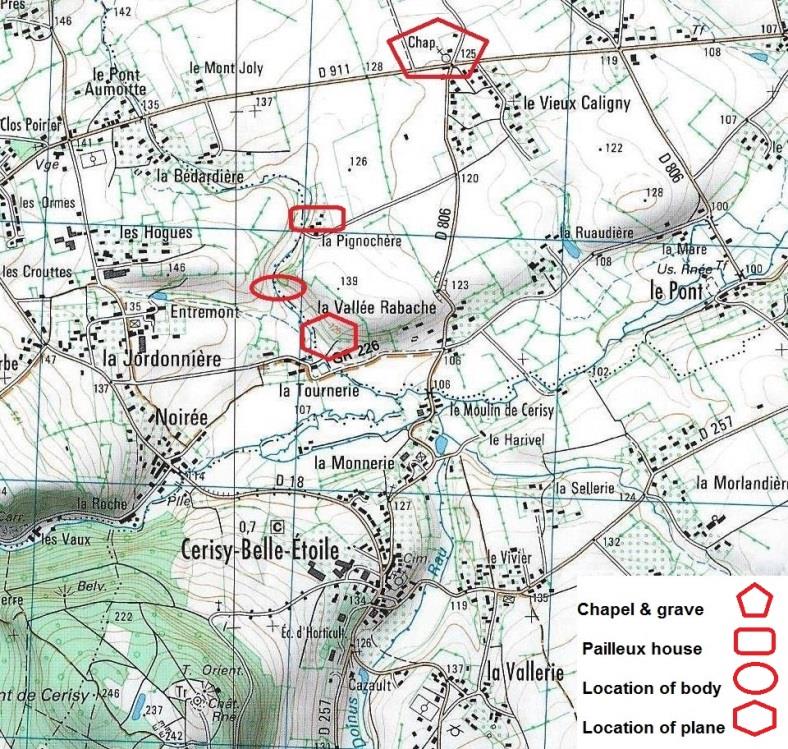
The map behind this map
Booklet map with four red annotations marking the chapel, Pailleux house, body location and aircraft location.
Amber · Booklet p. 17Archival reference for the exhibition map: chapel, Pailleux house, body and aircraft locations.
Inspect: The local map in the booklet

Archive object · caligny-reference

The local map in the booklet

Archival reference for the exhibition map: chapel, Pailleux house, body and aircraft locations.

Object record & original image

Extracted from Colin Mowl’s booklet; supplied exhibition research ZIP. Page 17. Reproduced in 2015.

Booklet p. 17; underlying map creator and reuse rights not established

AMBER · Supplied for private prototype / research. Public reuse rights not established; original or cleared replacement required.

Open supplied image ↗

The night of 5 August / About 8:30pm

Claude Pailleux.

A young resident of Caligny, Claude saw the aircraft come down. German soldiers gathered around George’s body.

After they had left, Claude brought George by hand cart to his parents’ house at La Pignochère.

Later, he wrote to George’s family. His letters preserved the account from the ground.

Read Claude’s account in the research pack

The pack summarises the aircraft coming down around 8:30pm, the Germans surrounding the body, and Claude recovering it after they left. He took George to his parents’ house by hand cart.

Editorial paraphrase, not a transcription. The pack identifies letters from 1946 and 1950; it supplies no full letter scan or day/month dates.
Sources / How do we know?

The evidence behind the story

How do we know?

This exhibition extends Colin Mowl’s commemorative booklet. The sources below record the provenance of its narrative, photographs and reconstructed route.

PRIMARY / CONTEMPORARY

Claude Pailleux’s letters to the Boucher family

1946 and 1950 · Research pack, chapters 9–11 and evidence model; Colin Mowl’s booklet

Participant correspondence, classified as primary in the supplied pack, although written after the events. Claude reports the aircraft coming down around 8:30pm, German soldiers around the body, and recovery by hand cart to his parents’ house after they left. Chapter 11 of the research pack preserves the promise fragment used here. The exhibition presents it as a typeset quotation, not an original letter image. No identifiable letter scan, full transcription, day/month dates or assignment of the excerpt to either letter is supplied.

INFERENCE / UNRESOLVED

The places around Caligny

5–6 August 1944; map reproduced in 2015 · Booklet p. 17 local map; research pack §§7–8

A simplified redraw follows the relative placement of the chapel, farm, body area, wreck area, roads and Mont de Cerisy in the supplied map. Chapel coordinate: 48.81554, −0.62217. Solid markers identify documented named places, not surveyed coordinates. Ellipses indicate approximate body/wreck areas; their sizes are illustrative. About 100 metres between body and wreck is a source statement, not a measured map scale. The numbered body → farm → chapel sequence records movement, not a known hand-cart path. Road strokes are simplified orientation references; no historical field boundaries are claimed.

PRIMARY / CONTEMPORARY

Early grave and crash-site photographs

After the burial; exact photograph dates unspecified · Booklet pp. 14 and 16; supplied asset manifest

The manifest identifies the early grave photograph and a crash-site photograph sent by Claude to George’s parents. Neither is captioned as a photograph of the funeral itself. All supplied booklet imagery remains Amber. Uncatalogued portraits and ceremony images have not been assigned identities or dates.

LATER RECOLLECTION

What the accounts cannot settle

1944 events; later accounts · Research pack §5; Colin Mowl’s discussion of conflicting accounts

A later dogfight account is not corroborated by the other pilots or squadron diary. Early accounts suggested George may have been shot while descending; Claude did not describe ground fire against him and believed the injuries were sustained in the aircraft. The precise cause and timing of his fatal injuries remain uncertain. No dogfight or injury mechanism is reconstructed.

Reading the evidence

  • PRIMARY / CONTEMPORARY
  • FIRST-HAND LATER
  • SECONDARY RECONSTRUCTION
  • LATER RECOLLECTION
  • INFERENCE / UNRESOLVED

Booklet-derived imagery remains Amber. Australian War Memorial downloads are separately recorded as public domain in their archive metadata.

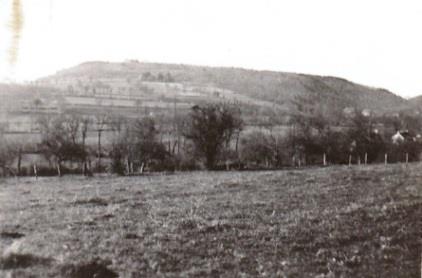
A field with trees and rising ground in the distance, reproduced as a crash-site photograph.
Amber · Booklet p. 16A crash-site photograph sent by Claude Pailleux to George’s parents.
Inspect: A photograph sent home

Archive object · crash-site

A photograph sent home

A crash-site photograph sent by Claude Pailleux to George’s parents.

Object record & original image

Extracted from Colin Mowl’s booklet; supplied exhibition research ZIP. Page 16. Exact photograph date unknown.

AMBER · Supplied for private prototype / research. Public reuse rights not established; original or cleared replacement required.

Open supplied image ↗

11 / 6 August 1944

The Funeral.

01 / An oak coffin

Made in the village.

A local carpenter made an oak coffin. The next day, villagers took George to the Chapel of Our Lady of the Oak.

02 / A procession

Others joined them.

Abbé Martin recalled about twenty people as the procession left La Pignochère. More joined along the way or waited at the chapel.

Claude estimated around one hundred at the funeral. The two accounts need not conflict.

03 / The chapel

A place for George.

George was buried beside the chapel. A propeller part was placed at his grave.
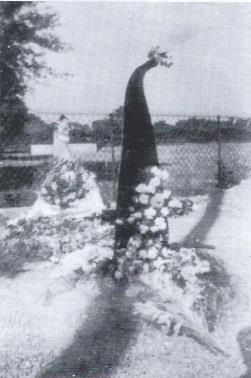
An early photograph of George’s grave, with flowers and a propeller part behind them.
Amber · Booklet p. 14George’s grave shortly after the funeral. This is a photograph of the grave, not the procession.
Inspect: The early grave

Archive object · early-grave

The early grave

George’s grave shortly after the funeral. This is a photograph of the grave, not the procession.

Object record & original image

Extracted from Colin Mowl’s booklet; supplied exhibition research ZIP. Page 14. After 6 August 1944; exact date unknown.

AMBER · Supplied for private prototype / research. Public reuse rights not established; original or cleared replacement required.

Open supplied image ↗
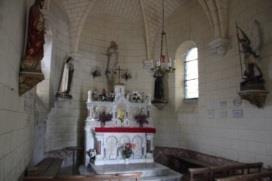
The small chapel interior, with altar, flowers and light from a side window.
Amber · Booklet p. 17The interior of the Chapel of Our Lady of the Oak. A later view, not a photograph of the 1944 funeral.
Inspect: Inside the chapel

Archive object · chapel-interior

Inside the chapel

The interior of the Chapel of Our Lady of the Oak. A later view, not a photograph of the 1944 funeral.

Object record & original image

Extracted from Colin Mowl’s booklet; supplied exhibition research ZIP. Page 17. Exact photograph date unknown.

AMBER · Supplied for private prototype / research. Public reuse rights not established; original or cleared replacement required.

Open supplied image ↗

Abbé Claude-Michel Martin / A participant remembers

Martin described the funeral as a patriotic demonstration, under the gaze of the Wehrmacht, with German tanks beneath the apple trees.

Paraphrase of his account as preserved in the booklet and research pack.

Sources / How do we know?

The evidence behind the story

How do we know?

This exhibition extends Colin Mowl’s commemorative booklet. The sources below record the provenance of its narrative, photographs and reconstructed route.

PRIMARY / CONTEMPORARY

Claude Pailleux’s letters to the Boucher family

1946 and 1950 · Research pack, chapters 9–11 and evidence model; Colin Mowl’s booklet

Participant correspondence, classified as primary in the supplied pack, although written after the events. Claude reports the aircraft coming down around 8:30pm, German soldiers around the body, and recovery by hand cart to his parents’ house after they left. Chapter 11 of the research pack preserves the promise fragment used here. The exhibition presents it as a typeset quotation, not an original letter image. No identifiable letter scan, full transcription, day/month dates or assignment of the excerpt to either letter is supplied.

FIRST-HAND LATER

Abbé Claude-Michel Martin’s account

First-hand account recorded later · Research pack, chapter 10 and people index; Colin Mowl’s booklet

Martin was sixteen in 1944 and attended the funeral. He recalled about twenty in the initial procession, with others joining or waiting at the chapel. Claude estimated around one hundred overall; the booklet explains that these need not conflict. Martin described a patriotic demonstration under the gaze of the Wehrmacht, with tanks under apple trees. Presented here as paraphrase, not an invented quotation.

PRIMARY / CONTEMPORARY

Early grave and crash-site photographs

After the burial; exact photograph dates unspecified · Booklet pp. 14 and 16; supplied asset manifest

The manifest identifies the early grave photograph and a crash-site photograph sent by Claude to George’s parents. Neither is captioned as a photograph of the funeral itself. All supplied booklet imagery remains Amber. Uncatalogued portraits and ceremony images have not been assigned identities or dates.

SECONDARY RECONSTRUCTION

Colin Mowl’s commemorative booklet

2015 · 24-page booklet; embedded images supplied in research ZIP

Prepared for the Caligny plaque unveiling on 6 June 2015. The ZIP contains image extractions, not the complete booklet PDF. The booklet identifies George in the 1934 King Edward VI School class photograph: aged 12, seated two places to the right of the master.

Reading the evidence

  • PRIMARY / CONTEMPORARY
  • FIRST-HAND LATER
  • SECONDARY RECONSTRUCTION
  • LATER RECOLLECTION
  • INFERENCE / UNRESOLVED

Booklet-derived imagery remains Amber. Australian War Memorial downloads are separately recorded as public domain in their archive metadata.

12 / Claude’s letter to George’s family

The Promise.

A promise to care for his grave

“with all the regard
due to a man who fell
far from his own country.”
Claude Pailleux, writing to the Boucher family.
Read the letter’s provenance

The evidence behind the story

How do we know?

This exhibition extends Colin Mowl’s commemorative booklet. The sources below record the provenance of its narrative, photographs and reconstructed route.

PRIMARY / CONTEMPORARY

Claude Pailleux’s letters to the Boucher family

1946 and 1950 · Research pack, chapters 9–11 and evidence model; Colin Mowl’s booklet

Participant correspondence, classified as primary in the supplied pack, although written after the events. Claude reports the aircraft coming down around 8:30pm, German soldiers around the body, and recovery by hand cart to his parents’ house after they left. Chapter 11 of the research pack preserves the promise fragment used here. The exhibition presents it as a typeset quotation, not an original letter image. No identifiable letter scan, full transcription, day/month dates or assignment of the excerpt to either letter is supplied.

Reading the evidence

  • PRIMARY / CONTEMPORARY
  • FIRST-HAND LATER
  • SECONDARY RECONSTRUCTION
  • LATER RECOLLECTION
  • INFERENCE / UNRESOLVED

Booklet-derived imagery remains Amber. Australian War Memorial downloads are separately recorded as public domain in their archive metadata.

George’s mother / Why he remained

Let him stay.

The family wanted George to remain at Caligny. When the Commonwealth War Graves Commission later proposed moving him to a military cemetery, his mother expressed the wish that he stay.

She believed it was what George would have wanted, remembering the French friends who had helped him during his escape.

In 1951, a CWGC headstone and surround were installed. The grave remained at the chapel, in the care of the people who had taken him in.
Sources / How do we know?

The evidence behind the story

How do we know?

This exhibition extends Colin Mowl’s commemorative booklet. The sources below record the provenance of its narrative, photographs and reconstructed route.

PRIMARY / CONTEMPORARY

Claude Pailleux’s letters to the Boucher family

1946 and 1950 · Research pack, chapters 9–11 and evidence model; Colin Mowl’s booklet

Participant correspondence, classified as primary in the supplied pack, although written after the events. Claude reports the aircraft coming down around 8:30pm, German soldiers around the body, and recovery by hand cart to his parents’ house after they left. Chapter 11 of the research pack preserves the promise fragment used here. The exhibition presents it as a typeset quotation, not an original letter image. No identifiable letter scan, full transcription, day/month dates or assignment of the excerpt to either letter is supplied.

SECONDARY RECONSTRUCTION

The family’s wish that George remain

After the war; headstone and surround installed in 1951 · Research pack, chapter 11; supplied Milestone C source summary

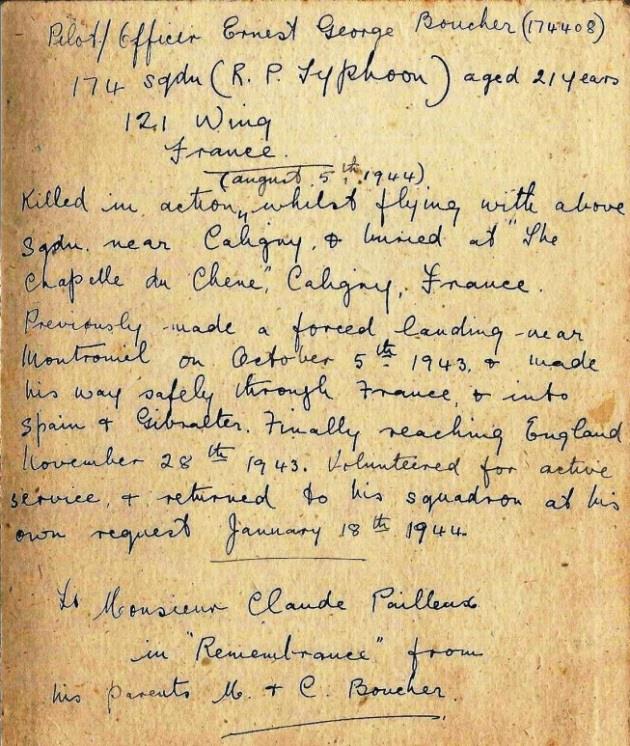
The family wished George to remain at Caligny. When a transfer to a military cemetery was proposed, his mother expressed the wish that he stay, linking it to the French friendship and help he had received. The supplied chronology dates the CWGC headstone and surround to 1951. The p. 14 handwritten dedication to Claude is a separate family object, not Claude’s letter or the mother’s transfer correspondence. It contains return dates that differ from the main researched chronology; those dates are not adopted.

Reading the evidence

  • PRIMARY / CONTEMPORARY
  • FIRST-HAND LATER
  • SECONDARY RECONSTRUCTION
  • LATER RECOLLECTION
  • INFERENCE / UNRESOLVED

Booklet-derived imagery remains Amber. Australian War Memorial downloads are separately recorded as public domain in their archive metadata.

Handwritten account of George’s life, ending with a remembrance dedication to Monsieur Claude Pailleux from his parents.
Amber · Booklet p. 14A handwritten remembrance dedication to Monsieur Claude Pailleux from George’s parents. A separate family document, not Claude’s promise letter.
Inspect: From George’s parents to Claude

Archive object · family-dedication

From George’s parents to Claude

A handwritten remembrance dedication to Monsieur Claude Pailleux from George’s parents. A separate family document, not Claude’s promise letter.

Transcription

To Monsieur Claude Pailleux / “in Remembrance” from / his parents M. & C. Boucher.

Selected visible text only; not a full diplomatic transcription.

Object record & original image

Extracted from Colin Mowl’s booklet; supplied exhibition research ZIP. Page 14. Undated in supplied extraction.

Booklet p. 14, image 17; dedication identified from the visible inscription. Other dates in this document differ from the booklet’s researched chronology and are not adopted here.

Selected inscription: To Monsieur Claude Pailleux / “in Remembrance” from / his parents M. & C. Boucher.

AMBER · Supplied for private prototype / research. Public reuse rights not established; original or cleared replacement required.

Open supplied image ↗
13 / People, place and care

Remembered.

The promise was kept.

The Pailleux family continued to care for the grave. The commune of Caligny continued to remember George.

Former 174 Squadron pilots visited. The Boucher and Pailleux families met and stayed connected. Ceremonies brought people back to the chapel.

Composite of George’s flower-covered grave, the chapel and its rural surroundings.
Amber · Booklet p. 3George’s grave and the Chapel of Our Lady of the Oak, shown in a booklet composite.
Inspect: A grave beside a chapel

Archive object · chapel

A grave beside a chapel

George’s grave and the Chapel of Our Lady of the Oak, shown in a booklet composite.

  1. A grave at the chapel

    On 6 August, villagers buried George. A propeller part was placed at the grave.

  2. Claude writes

    His correspondence with the Boucher family preserved what he had witnessed.

  3. The correspondence continues

    A further letter belongs to the evidence behind this story.

  4. He remained here

    A CWGC headstone and surround were installed. George’s grave stayed beside the chapel.

  5. A photographic tribute

    A photographic tribute was placed in the chapel.

  6. Gathering in remembrance

    A ceremony continued the village’s remembrance of George.

  7. Honouring those who helped

    On 6 June, a plaque was unveiled. Colin Mowl’s booklet honoured George and the French citizens who helped him in life and in death.

A continuing remembrance

A grave cared for.
A connection between families.

Sources / How do we know?

The evidence behind the story

How do we know?

This exhibition extends Colin Mowl’s commemorative booklet. The sources below record the provenance of its narrative, photographs and reconstructed route.

PRIMARY / CONTEMPORARY

Claude Pailleux’s letters to the Boucher family

1946 and 1950 · Research pack, chapters 9–11 and evidence model; Colin Mowl’s booklet

Participant correspondence, classified as primary in the supplied pack, although written after the events. Claude reports the aircraft coming down around 8:30pm, German soldiers around the body, and recovery by hand cart to his parents’ house after they left. Chapter 11 of the research pack preserves the promise fragment used here. The exhibition presents it as a typeset quotation, not an original letter image. No identifiable letter scan, full transcription, day/month dates or assignment of the excerpt to either letter is supplied.

SECONDARY RECONSTRUCTION

The family’s wish that George remain

After the war; headstone and surround installed in 1951 · Research pack, chapter 11; supplied Milestone C source summary

The family wished George to remain at Caligny. When a transfer to a military cemetery was proposed, his mother expressed the wish that he stay, linking it to the French friendship and help he had received. The supplied chronology dates the CWGC headstone and surround to 1951. The p. 14 handwritten dedication to Claude is a separate family object, not Claude’s letter or the mother’s transfer correspondence. It contains return dates that differ from the main researched chronology; those dates are not adopted.

SECONDARY RECONSTRUCTION

A continuing connection

1944–2015 and continuing remembrance · Research pack, chapter 12; supplied Milestone C remembrance chronology

The Pailleux family and commune cared for the grave; former squadron pilots visited and the families remained connected. The supplied chronology identifies a photographic tribute in 2002, a remembrance ceremony in 2014 and the plaque unveiling on 6 June 2015. Ongoing care is the booklet’s remembrance arc, not a claim of a newly verified ceremony or schedule today.

Reading the evidence

  • PRIMARY / CONTEMPORARY
  • FIRST-HAND LATER
  • SECONDARY RECONSTRUCTION
  • LATER RECOLLECTION
  • INFERENCE / UNRESOLVED

Booklet-derived imagery remains Amber. Australian War Memorial downloads are separately recorded as public domain in their archive metadata.

14 / The reading room

How do
we know?

A story held in letters,
records and memory.

This story is built from letters, official records, photographs and the recollections of those who were there.

Together they preserve both what can be established and the questions that remain.

01Primary / contemporary10 source records

Words, photographs and records made by participants and official bodies. Claude’s post-war letters are primary correspondence; their dates remain visible.

Return to Yellow One
PRIMARY / CONTEMPORARY

George Boucher’s Escape & Evasion Report

1943 · The National Archives · WO 208/3316/1595

George Boucher’s Escape & Evasion Report, reproduced in Colin Mowl’s source booklet. The Orchard quotation follows the wording reproduced there.

PRIMARY / CONTEMPORARY

174 Squadron Operations Record Book

5 August 1944 · The National Archives · AIR 27/1109 series; booklet extract, p. 10

The displayed object is the actual supplied booklet extract, not a reconstructed document. The research pack gives AIR 27/1109/16 as a catalogue lead only; the exact monthly item has not been verified and is not used as a formal citation. Highlighting marks only the lines about flak and Yellow 1 being hit. No German aircraft are reported in this contemporary evidence.

PRIMARY / CONTEMPORARY

George’s logbook

Wartime · Research pack §2; booklet research base

Identified as part of the booklet’s research base. No separately identifiable logbook scan or complete transcription is supplied here; the exhibition does not fabricate one.

PRIMARY / CONTEMPORARY

Frederick Grantham’s letter to George’s father

After the 5 August 1944 mission · Colin Mowl’s booklet, p. 10; supplied letter excerpt

Grantham describes anti-aircraft fire hitting the engine, George’s No. 2 following him towards Allied lines, and the bailout and opening parachute. His letter expresses hope that George could escape again. The excerpt is available below as an archive object.

PRIMARY / CONTEMPORARY

Claude Pailleux’s letters to the Boucher family

1946 and 1950 · Research pack, chapters 9–11 and evidence model; Colin Mowl’s booklet

Participant correspondence, classified as primary in the supplied pack, although written after the events. Claude reports the aircraft coming down around 8:30pm, German soldiers around the body, and recovery by hand cart to his parents’ house after they left. Chapter 11 of the research pack preserves the promise fragment used here. The exhibition presents it as a typeset quotation, not an original letter image. No identifiable letter scan, full transcription, day/month dates or assignment of the excerpt to either letter is supplied.

PRIMARY / CONTEMPORARY

Early grave and crash-site photographs

After the burial; exact photograph dates unspecified · Booklet pp. 14 and 16; supplied asset manifest

The manifest identifies the early grave photograph and a crash-site photograph sent by Claude to George’s parents. Neither is captioned as a photograph of the funeral itself. All supplied booklet imagery remains Amber. Uncatalogued portraits and ceremony images have not been assigned identities or dates.

PRIMARY / CONTEMPORARY

George’s final letter home

30 July 1944 · Family letter reproduced in Colin Mowl’s booklet, p. 9

A supplied excerpt of George’s handwritten final letter. The exhibition shows the actual extraction, without completing the letter or inventing missing text.

PRIMARY / CONTEMPORARY

174 Squadron group portrait

January–August 1943 · Australian War Memorial · P04374.001

AWM identifies Ernest George Boucher fourth from the left in the back row, at the top. This is an earlier squadron photograph, not a photograph of his January 1944 return or of B5. Copyright expired / public domain; downloaded on 6 September 2026.

Catalogue record ↗
PRIMARY / CONTEMPORARY

Life beside the airfield

July 1944 · Australian War Memorial · P02891.002

Members of 174 Squadron at B5 beside a tent, protective dugout and washing line, with a Typhoon nearby. George is not identified in this photograph. AWM marks copyright expired / public domain. Downloaded from the catalogue’s public image link on 6 September 2026.

Catalogue record ↗
PRIMARY / CONTEMPORARY

RAF coverage Caen (Ops T86 C/B 62)

7–8 July 1944 · Australian War Memorial · F02596 · RAF Film Production Unit

A 27-minute black-and-white silent film, marked copyright expired / public domain by AWM. The catalogue identifies a sequence of 174 Squadron laundry, maintenance, armament preparation and aircraft departures. The full reel also covers other units. Only the reviewed squadron ground sequence is used here; no person in the film is identified as George. See film metadata for the exact excerpt.

Catalogue record ↗
An early photograph of George’s grave, with flowers and a propeller part behind them.
Amber · Booklet p. 14George’s grave shortly after the funeral. This is a photograph of the grave, not the procession.
Inspect: The early grave

Archive object · early-grave

The early grave

George’s grave shortly after the funeral. This is a photograph of the grave, not the procession.

Object record & original image

Extracted from Colin Mowl’s booklet; supplied exhibition research ZIP. Page 14. After 6 August 1944; exact date unknown.

AMBER · Supplied for private prototype / research. Public reuse rights not established; original or cleared replacement required.

Open supplied image ↗
02First-hand later2 source records

People who were there, looking back: valuable testimony read with attention to when it was recorded.

Return to the funeral
FIRST-HAND LATER

Jimmie Spencer: a fellow pilot remembers

Recorded after the war · Research pack, chapters 6–7 and evidence model

Spencer’s squadron recollections are first-hand later evidence. The earlier chapter’s source label records their retrospective nature as “Later recollection”; that does not make them the same as the disputed local dogfight story. Only the short excerpts supplied in the pack are used.

FIRST-HAND LATER

Abbé Claude-Michel Martin’s account

First-hand account recorded later · Research pack, chapter 10 and people index; Colin Mowl’s booklet

Martin was sixteen in 1944 and attended the funeral. He recalled about twenty in the initial procession, with others joining or waiting at the chapel. Claude estimated around one hundred overall; the booklet explains that these need not conflict. Martin described a patriotic demonstration under the gaze of the Wehrmacht, with tanks under apple trees. Presented here as paraphrase, not an invented quotation.

03Secondary reconstruction4 source records

Colin Mowl’s booklet is the narrative foundation. The research pack brings its evidence, family history and remembrance together.

Return to remembrance
SECONDARY RECONSTRUCTION

Colin Mowl’s commemorative booklet

2015 · 24-page booklet; embedded images supplied in research ZIP

Prepared for the Caligny plaque unveiling on 6 June 2015. The ZIP contains image extractions, not the complete booklet PDF. The booklet identifies George in the 1934 King Edward VI School class photograph: aged 12, seated two places to the right of the master.

SECONDARY RECONSTRUCTION

Digital Exhibition Pack

5 September 2026 · Supplied research brief, §§2–5, 7–11

The factual brief for this exhibition. Summarises Colin Mowl’s 2015 booklet and identifies its underlying records.

SECONDARY RECONSTRUCTION

The family’s wish that George remain

After the war; headstone and surround installed in 1951 · Research pack, chapter 11; supplied Milestone C source summary

The family wished George to remain at Caligny. When a transfer to a military cemetery was proposed, his mother expressed the wish that he stay, linking it to the French friendship and help he had received. The supplied chronology dates the CWGC headstone and surround to 1951. The p. 14 handwritten dedication to Claude is a separate family object, not Claude’s letter or the mother’s transfer correspondence. It contains return dates that differ from the main researched chronology; those dates are not adopted.

SECONDARY RECONSTRUCTION

A continuing connection

1944–2015 and continuing remembrance · Research pack, chapter 12; supplied Milestone C remembrance chronology

The Pailleux family and commune cared for the grave; former squadron pilots visited and the families remained connected. The supplied chronology identifies a photographic tribute in 2002, a remembrance ceremony in 2014 and the plaque unveiling on 6 June 2015. Ongoing care is the booklet’s remembrance arc, not a claim of a newly verified ceremony or schedule today.

Handwritten account of George’s life, ending with a remembrance dedication to Monsieur Claude Pailleux from his parents.
Amber · Booklet p. 14A handwritten remembrance dedication to Monsieur Claude Pailleux from George’s parents. A separate family document, not Claude’s promise letter.
Inspect: From George’s parents to Claude

Archive object · family-dedication

From George’s parents to Claude

A handwritten remembrance dedication to Monsieur Claude Pailleux from George’s parents. A separate family document, not Claude’s promise letter.

Transcription

To Monsieur Claude Pailleux / “in Remembrance” from / his parents M. & C. Boucher.

Selected visible text only; not a full diplomatic transcription.

Object record & original image

Extracted from Colin Mowl’s booklet; supplied exhibition research ZIP. Page 14. Undated in supplied extraction.

Booklet p. 14, image 17; dedication identified from the visible inscription. Other dates in this document differ from the booklet’s researched chronology and are not adopted here.

Selected inscription: To Monsieur Claude Pailleux / “in Remembrance” from / his parents M. & C. Boucher.

AMBER · Supplied for private prototype / research. Public reuse rights not established; original or cleared replacement required.

Open supplied image ↗
04Later recollection / uncertain1 source records

Where the underlying research leaves a question open, the exhibition leaves it open too.

Return to Caligny
LATER RECOLLECTION

What the accounts cannot settle

1944 events; later accounts · Research pack §5; Colin Mowl’s discussion of conflicting accounts

A later dogfight account is not corroborated by the other pilots or squadron diary. Early accounts suggested George may have been shot while descending; Claude did not describe ground fire against him and believed the injuries were sustained in the aircraft. The precise cause and timing of his fatal injuries remain uncertain. No dogfight or injury mechanism is reconstructed.

05Inference / approximate2 source records

Known places can be connected without claiming to know every road, field or footstep between them.

Return to the local map
INFERENCE / UNRESOLVED

Reconstructing the escape

October 1943 · Research brief §§3, 5, 7–8; booklet route map, p. 6

Named stops are documented in the supplied reconstruction. The diagram is schematic and not to scale. Dashed segments indicate approximate connections, not roads, paths or border-crossing coordinates. La Munia is an area, not a confirmed pass.

INFERENCE / UNRESOLVED

The places around Caligny

5–6 August 1944; map reproduced in 2015 · Booklet p. 17 local map; research pack §§7–8

A simplified redraw follows the relative placement of the chapel, farm, body area, wreck area, roads and Mont de Cerisy in the supplied map. Chapel coordinate: 48.81554, −0.62217. Solid markers identify documented named places, not surveyed coordinates. Ellipses indicate approximate body/wreck areas; their sizes are illustrative. About 100 metres between body and wreck is a source statement, not a measured map scale. The numbered body → farm → chapel sequence records movement, not a known hand-cart path. Road strokes are simplified orientation references; no historical field boundaries are claimed.

Booklet map with four red annotations marking the chapel, Pailleux house, body location and aircraft location.
Amber · Booklet p. 17Archival reference for the exhibition map: chapel, Pailleux house, body and aircraft locations.
Inspect: The local map in the booklet

Archive object · caligny-reference

The local map in the booklet

Archival reference for the exhibition map: chapel, Pailleux house, body and aircraft locations.

Object record & original image

Extracted from Colin Mowl’s booklet; supplied exhibition research ZIP. Page 17. Reproduced in 2015.

Booklet p. 17; underlying map creator and reuse rights not established

AMBER · Supplied for private prototype / research. Public reuse rights not established; original or cleared replacement required.

Open supplied image ↗
Revisit the booklet’s escape map
Booklet map showing the escape route south through France to Spain.
Amber · Booklet p. 6The booklet’s reconstruction of George’s route through France to Spain.
Inspect: The route in the booklet

Archive object · route-map

The route in the booklet

The booklet’s reconstruction of George’s route through France to Spain.

Open supplied route map ↗
RAF badge and inscription on George Boucher’s headstone.
Amber · Booklet p. 3Detail of George Boucher’s Commonwealth War Graves headstone.
Inspect: The name in stone

Archive object · headstone

The name in stone

Detail of George Boucher’s Commonwealth War Graves headstone.

Transcription

Selected inscription: “PILOT OFFICER / E. G. BOUCHER / ROYAL AIR FORCE / 5TH AUGUST 1944 AGE 21”.

Selected visible text only; not a full diplomatic transcription.

Open the headstone photograph ↗

The Chapel of Our Lady of the Oak / Caligny

He remained here.
They cared for him.

Ernest George Boucher
1922–1944

Return to Pop’s Projects ↗Back to the beginning ↑